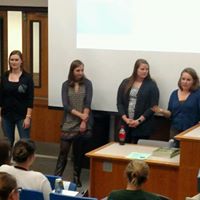
- Emily G - Push yourself out of your comfort zone! The best way to get better is to tackle as much of the session as you can!
- Chris - Don’t expect to know everything your first day, week, or month. There is a lot of material to know, so be kind and try not to place unrealistic expectations on yourself. You will continue the learning even after finishing a given a rotation.
- Brooke - You’re going to make mistakes and that is very okay. Accept constructive criticism and move forward. Don’t be afraid to ask questions as it is the best way to learn from the experts you’re surrounded by.
- Leslie - Be open and flexible! This is an entirely new way of learning and it might feel uncomfortable at first. You’re not ever working to perfect your process, but rather continuously learning how to react to the cases/situations that you find yourself in. Don’t ever be afraid to ask questions or try something new in a session. Your mentors have a wealth of knowledge and experience and will guide you through the process.
- Sam- The genetic counselors you will be working with are well versed and knowledgeable. Take advantage and ask questions about anything and everything.
- Kavitha - I found it helpful to take a few minutes at the end of each rotation block to reflect on what I had learned and what I had accomplished during that block. That way I saw how much I had done in a few short weeks and I had an idea of specific skills to work on in the next block.
- Bryony - Make an effort to manage your time well and stay on top of things. Too much procrastination can result in overwhelming work loads, so it’s best to complete assignments as they come.
- Michelle - You will have fantastic days and rough days. The fantastic days are easy. For the rough days, just get through, move on to the next thing, and remember that people generally learn more from their failures than their successes.
- Emily M - Make sure you take time for yourself, too. Rotations can be emotionally taxing, so sometimes a run or a manicure is needed!
- Anna - Push yourself to do the things that scare you in rotations. Ask psychosocial questions, do the next portion of the appointment, crack a joke. You will be amazed at how well things turn out and you will find your own style!
- Sara - Write scripts for yourself to nail down the simple explanations so that you can focus on more complex skills.
Perspectives on graduate student life from Pitt Genetic Counseling Students.
Friday, April 28, 2017
Advice on Clinical Rotations
With the Class of 2018 starting their clinical rotations, the Class of 2017 has some words of advice on how to be successful.
Friday, April 14, 2017
Pitt Genetic Counseling Assistants Share Their Experiences
I work as a genetic counseling assistant at Magee-Womens Hospital of UPMC in the Center for Medical Genetics and Genomics. One of the aspects that attracted me to the genetic counseling assistant position was the opportunity to learn the ‘behind the scenes’ aspects and responsibilities of genetic counseling. Although most of my shadowing experience was in prenatal genetic counseling prior to entering the program, through this position I have learned a great deal more about prenatal counseling over these past few months. Through my position I have been able to be involved in various aspects of case preparation, ordering testing, calling out results, and case follow-up. I had no idea just how timing consuming and extensive case follow-up can be for counselors. Calling insurance companies about coverage for genetic testing can take hours.
Through my position I contact laboratories to determine the appropriate steps for testing specific genes, contacting patients with normal results, completing test requisition forms, preparing blood samples for shipping and consenting low risk patients referred for Non-invasive prenatal testing (NIPT) with the appropriate supervision by the genetic counselors. My basic duties working within an academic research hospital with a busy genetic counseling and ultrasound staff every day is different but I’ve learned to expect the unexpected when I go to work. Cases are scheduled unexpectedly and unanticipated challenges arise but working at Magee over the past few months has helped me to learn how to embrace these challenges rather than becoming overwhelmed. I love being a part of a team that is always willing to collaborate with one another to tackle challenges or plan an office party. Even though I have only worked in this position for a few months, I truly feel like I am a part of the genetics team at Magee.
As a Genetic Counseling Assistant, I spend my time at work immersed in the day-to-day operations of a busy genetic counseling office, which I believe will serve me well when I enter the field. As a GC assistant in the cancer genetics department of Magee Womens Hospital in Pittsburgh, I am involved in reviewing lab reports, insurance correspondence, case preparation materials, data entry, and collecting family history information. In working on these tasks, I gain valuable experience for my chosen career and contribute to the operation of a busy genetic counseling clinic and assist the genetic counselors in the office with administrative tasks that allow them to focus more on patient care. Having the opportunity to collaborate so closely with practicing genetic counselors is an amazing opportunity.
Working with the experienced staff at Magee Womens Hospital has helped me learn a great deal about genetic counseling as a profession. I have seen how they interact with patients, physicians, and each other. I envy their ability to manage their work so efficiently, and hope that I may somehow absorb some of that talent just by being there and watching the strategies they use. The part of my job I enjoy the most is seeing firsthand how my chosen profession is respected by clinicians, and appreciated by patients.
I currently work as a Genetic Counseling Assistant at the Allegheny Health Network Cancer Genetics program. I was very excited to start the position because I have always had a strong interest in cancer genetics and have had very positive experiences working within the Allegheny Health Network previously. Through this position, I have been involved in a wide variety of different roles to help with the daily functioning of the clinic, and my work has helped to prepare me for the start of my clinical rotations.
One major role that I have been a part of is learning how to navigate the electronic medical record system called Epic. I was able to receive Epic training and have since been involved in scanning patient records, locating information relevant to their upcoming cancer genetic sessions, and learning how to construct template letters. I have also been fortunate enough to be able to call patients to gather their family history prior to appointments. This experience has immensely improved my confidence in talking to patients and knowing important questions to ask when gathering a comprehensive family history. Similarly, I occasionally gather surgical pathology records and progress reports for patients who have had previous biopsies. Gathering this information has allowed me to start to practice compiling both family history and pathology information to hypothesize about potential hereditary cancer syndromes. In the future, I may transition into gathering family histories prior to scheduling patients and presenting it to the counselors to help them to decide if the family history appears to be consistent with a hereditary cancer condition and if they would meet specific testing criteria. Other roles that I have such as updating standards and procedures for the clinic, tracking laboratory and insurance company relationships, and ordering testing supplies have all provided me with a better idea of the behind the scenes work that goes into running a cancer genetics clinic.
In addition to providing an opportunity to practice skills that I have learned in class such as taking a cancer family history, my position provides me with access to a wealth of educational resources. First and foremost, the counselors at AHN are incredibly knowledgeable and are always open to answering any questions that I may have about a particular cancer syndrome. I have also attended several multidisciplinary tumor board meetings during which oncologists, genetic counselors, surgeons, and other health care professionals discuss updates in their area of practice and often use cases to illustrate their points. Under the guidance of the counselors, I have also reviewed literature about specific cancer syndromes and helped to update patient educational materials to provide them with the most accurate information.
Another wonderful component about working as a GCA in the realm of cancer genetics is that I intend to focus my thesis project on information gathered from our clinic about surgical decision making patterns for clients found to have mutations in “lower risk,” moderate penetrance genes associated with hereditary breast and ovarian cancers. I am very excited to have the opportunity to be able to delve into studying an area of genetic counseling that I am particularly interested in and passionate about.
Overall, every time I go into work, I feel as though I have the opportunity to learn more about the science and skills involved in running a cancer genetics clinic. Working as a GCA has helped me to expand my knowledge and improve my confidence so that I feel more prepared to make the transition into rotations.
Through my position I contact laboratories to determine the appropriate steps for testing specific genes, contacting patients with normal results, completing test requisition forms, preparing blood samples for shipping and consenting low risk patients referred for Non-invasive prenatal testing (NIPT) with the appropriate supervision by the genetic counselors. My basic duties working within an academic research hospital with a busy genetic counseling and ultrasound staff every day is different but I’ve learned to expect the unexpected when I go to work. Cases are scheduled unexpectedly and unanticipated challenges arise but working at Magee over the past few months has helped me to learn how to embrace these challenges rather than becoming overwhelmed. I love being a part of a team that is always willing to collaborate with one another to tackle challenges or plan an office party. Even though I have only worked in this position for a few months, I truly feel like I am a part of the genetics team at Magee.
-- Joya B
As a Genetic Counseling Assistant, I spend my time at work immersed in the day-to-day operations of a busy genetic counseling office, which I believe will serve me well when I enter the field. As a GC assistant in the cancer genetics department of Magee Womens Hospital in Pittsburgh, I am involved in reviewing lab reports, insurance correspondence, case preparation materials, data entry, and collecting family history information. In working on these tasks, I gain valuable experience for my chosen career and contribute to the operation of a busy genetic counseling clinic and assist the genetic counselors in the office with administrative tasks that allow them to focus more on patient care. Having the opportunity to collaborate so closely with practicing genetic counselors is an amazing opportunity.
Working with the experienced staff at Magee Womens Hospital has helped me learn a great deal about genetic counseling as a profession. I have seen how they interact with patients, physicians, and each other. I envy their ability to manage their work so efficiently, and hope that I may somehow absorb some of that talent just by being there and watching the strategies they use. The part of my job I enjoy the most is seeing firsthand how my chosen profession is respected by clinicians, and appreciated by patients.
-- Seth Lascurain
One major role that I have been a part of is learning how to navigate the electronic medical record system called Epic. I was able to receive Epic training and have since been involved in scanning patient records, locating information relevant to their upcoming cancer genetic sessions, and learning how to construct template letters. I have also been fortunate enough to be able to call patients to gather their family history prior to appointments. This experience has immensely improved my confidence in talking to patients and knowing important questions to ask when gathering a comprehensive family history. Similarly, I occasionally gather surgical pathology records and progress reports for patients who have had previous biopsies. Gathering this information has allowed me to start to practice compiling both family history and pathology information to hypothesize about potential hereditary cancer syndromes. In the future, I may transition into gathering family histories prior to scheduling patients and presenting it to the counselors to help them to decide if the family history appears to be consistent with a hereditary cancer condition and if they would meet specific testing criteria. Other roles that I have such as updating standards and procedures for the clinic, tracking laboratory and insurance company relationships, and ordering testing supplies have all provided me with a better idea of the behind the scenes work that goes into running a cancer genetics clinic.
In addition to providing an opportunity to practice skills that I have learned in class such as taking a cancer family history, my position provides me with access to a wealth of educational resources. First and foremost, the counselors at AHN are incredibly knowledgeable and are always open to answering any questions that I may have about a particular cancer syndrome. I have also attended several multidisciplinary tumor board meetings during which oncologists, genetic counselors, surgeons, and other health care professionals discuss updates in their area of practice and often use cases to illustrate their points. Under the guidance of the counselors, I have also reviewed literature about specific cancer syndromes and helped to update patient educational materials to provide them with the most accurate information.
Another wonderful component about working as a GCA in the realm of cancer genetics is that I intend to focus my thesis project on information gathered from our clinic about surgical decision making patterns for clients found to have mutations in “lower risk,” moderate penetrance genes associated with hereditary breast and ovarian cancers. I am very excited to have the opportunity to be able to delve into studying an area of genetic counseling that I am particularly interested in and passionate about.
Overall, every time I go into work, I feel as though I have the opportunity to learn more about the science and skills involved in running a cancer genetics clinic. Working as a GCA has helped me to expand my knowledge and improve my confidence so that I feel more prepared to make the transition into rotations.
-- Jackie Amurgis
Friday, March 31, 2017
Transitioning from Student to Genetic Counselor
During the spring semester of my second year of graduate training, I accepted a position at the University of Iowa Holden Comprehensive Cancer Center (UIHC) as a cancer genetic counselor. From the time I first interviewed it was evident that a number of exciting things were on the horizon for genetic counseling at UIHC. I was recruited along with five other new genetic counseling hires for various positions across the hospital, breaking a national recorded for the most new clinical genetic counseling hires at an academic medical center institution.

Since starting my job just over seven months ago, I have had the opportunity to attend the National Society of Genetic Counselors Annual Education Conference in Seattle and the Iowa Cancer Consortium in Des Moines, as well as give a number of presentations at tumor boards, other specialty meetings, and conferences. The most memorable activity I have participated in, to date, was on my third day when we took part in one of the official satellites for former Vice President Biden’s Cancer Moonshot. The Cancer Moonshot was a call to action for all those involved in cancer care and research to help end cancer as we know it. During the event we heard from a local panel including physicians, researchers, and patients as well as a moving and powerful speech from Vice President Biden as he shared the story of his son, Bo.
One of the most significant changes I noticed when starting my genetic counseling career was that I was now in charge. I was the expert in the room and had to be prepared to answer any question the patients may have. I was also seen as the expert in tumor boards, often fielding questions about appropriate referrals to our clinic. This was both exhilarating and overwhelming. Fortunately, I quickly overcame these feelings and became an integrated part of the patient care team. I found it important to remember that I may not know everything, but I am still the genetics expert. It is okay to say you do not know the answer, but you will look into the question to find the answer. I also found myself using the counseling strategies my supervisors used in clinical rotations, whether that is to get a patient to open up more, facilitate decision-making, or to help refocus a patient to get the session back on track.
Pitt did a wonderful job preparing us for our genetic counseling careers. The only thing I was probably not prepared for is not being around the 10 wonderful classmates I spent so much time with for two years! This was a significant adjustment but luckily we keep in touch and are available to each other to discuss ideas and provide support after having a difficult case. We also make plans for class trips so we can see each other stress-free. Although it has been hard not seeing these wonderful friends every day, there is a great group of genetic counselors across UIHC who help provide support. I was hired at the same time as other new graduates and we areable to support each other and studied together for the ABGC certification examination. I was thrilled to pass the exam!
At my job, we have a social chair who plans monthly activities for genetic counselors to get together, which helps foster a strong relationship and friendship with the other genetic counselors at our institution. There is a monthly book club that includes genetic counselors as well as other cancer center staff. I also have the opportunity to work with two (soon to be three) wonderful genetic counselors in the cancer center, that we endearingly refer to as “the dream team”.
With all the changes that are coming to the UIHC and the excellent training I received at Pitt, I know I will be able to take my career down whatever path I choose, whether that be teaching, research, or clinical work. Coming to UIHC has been a wonderful transition into the workforce that provides me with endless opportunity to grow.
-Kristin Gambin, Class of 2016
Friday, March 17, 2017
Thoughts for Interviewees from Current Students
1. Congratulations!
You have an interview! Take a moment to celebrate this achievement. Applications take significant time and effort – writing personal statements, getting recommendations, and sending out copies of your transcripts. All that work has paid off and has resulted in an interview, make sure to enjoy it before tackling the next steps.2. Come with questions
The interviews are a way for you to learn more about the program than you can read from the website. You are interviewing the program just as much as they are interviewing you. Are any of your interviewers alumni? Ask them why they chose the program, how it has changed, and where they see it going. Some of our favorite questions were:- What makes the program unique?
- How can I personalize my learning experience?
- How many cases do students typically see?
3. Talk to current students
Current students can give you an important perspective of what life in the program would be like including activities outside of classes and rotations. Find out what’s everyone’s favorite hangout spot. Where do students live? How affordable is the area? Do students work? In addition, it’s fun to meet future colleagues!
4. Explore the city
Especially near campus. You’re going to spend at least two years wherever you decide to go. Are there interesting things to do? Is it easy to get around? Try out some of the public transportation. Check out some of the local parks and unique sites.5. Keep a list
And update it as you complete your interviews. It’s handy to have a priority list before Decision Day arrives. You can keep in mind factors that are important to you when making a decision.Our biggest advice would be to just breathe, be yourself, and have fun!
Best of luck,
Classes of 2017 and 2018
Friday, March 3, 2017
Mulling Over Ethics as Genetic Counseling Students
I
find that one of the unique aspects of the Pitt Genetic Counseling Program is
the strong focus on ethical principles in the curriculum. For example, students participate in a course
entitled, “Ethical Issues in Clinical and Public Health Genetics,” in their
first and second year. The purpose of the course is to discuss genomics and
genetic counseling topics within an ethical framework.
For
the course, each week, a first and second-year student pair up to present a
topic on which they lead the class discussion. The topics that I have had the
pleasure of discussing have been equally intriguing and challenging; they are
always pertinent to current issues in the field as well as conundrums that may
be faced in the future, especially as genomic technology advances so rapidly.
Some examples of topics from my favorite discussions include: post-mortem
genetic testing, language barriers and the use of interpreters, prenatal whole
exome sequencing, the addition of diseases to newborn screening, and population
screening for BRAC1/2 mutations.
Although
we touch on ethical principles in many of our classes throughout the program,
this course is different due to our instructors. We are lucky to have Dr. Lisa
Parker co-lead the class with our program director, Dr. Robin Grubs. Dr. Parker
is a philosopher-bioethicist whose research focuses on genetic research,
genetic counseling, and pharmacogenomics. She brings a nuanced ethical insight
to every class and can play a perfect “devil’s advocate”, which allows us to
see a situation from multiple perspectives. I feel that her background and
expertise help to encourage us to grapple with the ethical quandaries that we
tend to find ourselves in during these discussions.
Overall,
I find the ethics course extremely beneficial as a genetic counseling student.
As a first-year student, I was fascinated by the insight of our second-year
students. It was amazing to see how much they had learned from their rotations
and how personal experiences with patients gave them unique insights into
certain ethical situations. Now, as a second year, I feel that the ethics
discussions allow me to think critically about my patient interactions and to
learn from the experiences of my classmates. It doesn’t matter how much I think
I know about a topic prior to the discussion, I always come away with a more
refined view.
-
-Emily Griffenkranz, Class of 2017
Friday, February 17, 2017
Pitt's Genetic Counseling Club off to a Good Start
A passion for science combined with a desire to understand
people fosters unique character. It cultivates a person with empathy and strength,
focus and balance. This person is a genetic counselor.
Unfortunately, this isn’t a career typically found on a high
school aptitude test…
Thus, like many students in their final years of high
school, I found myself trying to decide where to go to college with no real
understanding of myself or my professional calling. I knew I didn’t want to be
submerged in medicine, but also didn’t want a job that focused on working with
people without a science component. When I asked my high school biology teacher
if any jobs existed somewhere in the middle, he asked:
This question sparked my curiosity and fueled what is now my
burning passion. Though my teacher didn’t know much more about this oddly
balanced profession, I ventured out on my own to find more information.
In my searches, I realized that genetic counseling was not just
something I wanted to do, but a profession that I was made to do. Throughout
high school, I was involved in many theater and music programs, but also enjoyed
going home to a date night with my biology book. I started looking for colleges,
and happily landed at the University of Pittsburgh, where I decided to pursue a
Biological Sciences Major and take as many classes focusing on genetics and the
human body as possible. In addition, I decided to pursue a Music Minor and an
American Sign Language Certificate to balance the scientific and psychosocial
aspects of my education. Ultimately, I considered this a stepping stone to a graduate
program in genetic counseling.
Throughout my undergraduate career, I found myself having to
do a lot of independent research on how to get into a genetic counseling graduate
program. I had to research which classes constituted as prerequisites and which
activities would help prepare for a career in genetic counseling. The many
times I had questions, I didn’t have anyone else to ask or even someone to
compare notes with. By no fault of theirs, career offices and professors had
limited answers because genetic counseling is such a niche field. Additionally,
I didn’t feel comfortable contacting the head of the Pitt program as a young
college student, worried that if I applied to Pitt, they would remember me as unknowledgeable!
(Note
from program directors at Pitt: This is not the case! We welcome contact from
students at any stage in finding out about genetic counseling to contact us!)
Fast forward to my senior year; the Assistant Director of
Pitt’s genetic counseling program, Andrea Durst, approached me about starting a
genetic counseling club at the undergraduate level. Although I had decided to
take a gap year before going on to graduate school, I realized that I wanted to
serve as a mentor for those sitting in the same position I had four years ago. My
fellow officers and I hope this club will be able to not only serve as support
system for those who know they want to become genetic counselors, but also to
inspire and educate those who have only heard whispers of this great
profession.
Thus far, the club has had two meetings, elected a new
Volunteer Coordinator, and gained over 20 members to its roster. We are looking
forward to having many students and genetic counselors attend to share their
experiences, tips and tricks, and open a line of communication for anybody who
wants to learn. If you have any questions, or would like to be added to our
email list (you do not have to be an undergrad at Pitt!), please feel free to
email PittGeneticCounselingClub@gmail.com.
-Jessica Feldman, President of the Pitt Genetic Counseling Club
Friday, February 3, 2017
Educational Opportunities
The Pitt genetic counseling students have the opportunity to participate in a number of educational experiences that enhance their training including educating high school and undergraduate students about the genetic counseling profession. Read on to learn about some of our students’ experiences educating others about genetic counseling.

“I really value my experience leading small group
discussions with some AP Psychology high school students. We worked through a
genetic counseling session together as a group and discussed complex ethical
issues surrounding genetic testing. I was very struck by how thoughtful they
were in their answers. They were all very interested in genetics and
compassionate regarding how it could have a major impact on people’s lives. As
the leader of this discussion, it was the first time I was in an ‘expert’ role
in regards to genetic knowledge, and having such a positive interaction early
in my educational experience gave me great insight into the role of a genetic
counselor in a session before I entered into rotations.” - Emily Griffenkranz,
Class of 2017
“I had the opportunity to speak to the Tri Beta biology
honors society about genetic counseling this semester, and I really enjoyed the
experience. I ultimately decided to become a genetic counselor after listening
to some graduate students talk about their program, so after speaking to the
undergrads about my program I felt as though I had come full circle. I can only
hope that our discussion inspired one of the students in the audience in the
same way that I was inspired by genetic counseling students when I was in
college” - Julia Stone, Class of 2018

“I spoke to some students in Grove City, PA about genetic counseling and my experiences in Pitt’s program thus far. Although most students in the room were on the pre-med track, I still think it was important information to pass on to future medical professionals so they can better direct people to genetics services in the future. I believe educating people about what genetic counselors can do is a major component of growing the profession and expanding personalized medicine throughout our healthcare system.” - Meg Hager, Class of 2018
“Educational experiences at the University of Pittsburgh allowed me to share my passion for public health and genetic counseling with high school students who were part of the Health Career Scholars Academy. I was able to first introduce careers in public health and then specifically genetic counseling and its applications to public health to these students. The students were then divided into groups and I was able to go through a genetic counseling scenario and discuss public health and ethical implications. It was really amazing to not only share my passion, but to also hear the thoughts of my future fellow public health professionals.” - Brooke Hornak, Class of 2017

“I spent a day last year getting to talk with some amazing
teenagers affiliated with the Huntington’s Disease Society of America’s
National Youth Alliance at their annual conference. These teenagers and young adults are
personally affected by Huntington’s disease, and wanted to learn more about
genetic testing options available for them in the future. To facilitate a thoughtful discussion, we
broke up into small groups and role-played scenarios involving individuals
trying to decide when and how to get tested for Huntington’s disease. The teens were amazing; right away they
understood the emotional complexities that come with testing, and were
wonderfully gracious in sharing their own personal experiences with me. It’s always a wonderful experience to help
educate others about genetics, but this particular group was a pleasure to work
with, and I was so grateful that they allowed me to listen to their own
journeys and struggles with Huntington’s.” - Emily Massiello, Class of 2017
Subscribe to:
Posts (Atom)